
Mansfield Historical Directory Holdings
The strongest Mansfield address-to-occupant run is not a fully cataloged commercial city-directory shelf. It is the Mansfield Street Listings collection in the Public Library's Certuse Room. The holdings page identifies listings from 1870 through 2021, with missing years. A separate digitized volume, the 1918 A.E. Foss regional directory, supplies street and inhabitant material for Mansfield alongside Norton and Raynham. The public holdings page does not provide a complete publisher-by-year catalog for Mansfield commercial or reverse directories. It also does not establish that a criss-cross shelf exists. Ask the library for call numbers, exact years, and gaps before treating any run as continuous.
| Collection | Years | Where Held | Access |
|---|---|---|---|
| Mansfield Street Listings | 1870-2021, missing years | Mansfield Public Library Certuse Room | Ask library staff; historical address-to-occupant research |
| A.E. Foss regional directory | 1918 | Internet Archive scan; possible library print requires confirmation | Public digitized scan; street and inhabitant sections |
| Mansfield News | 1873-1976 online; 1977-2022 library-only | Mansfield Public Library and newspaper archive | Notices, obituaries, civic and address context |
| Mansfield High School yearbooks | 1926-present, missing years | Mansfield Public Library Certuse Room | School-year and former-classmate research |
| Historical House files | Undated local holdings | Mansfield Public Library Certuse Room | On-site address research; not every older property is represented |
Mansfield historical directories need date checks at every turn. The library documents missing Street Listings and yearbooks, while the regional 1918 volume is a single known edition rather than proof of a yearly Mansfield series. A gap can mean that an issue is absent, that a person was not listed, or that the available collection changed format. Preserve the year and source for every observation.
Mansfield Directory in 1918
The digitized Mansfield, Norton, and Raynham Massachusetts Directory 1918 is a 258-page A.E. Foss Co. regional volume. Its contents list Census on page 30, Street Directory on page 57, Inhabitants on page 61, Business Directory on page 139, and town officers, schools, libraries, churches, fire department, fraternal orders, and post offices later in the book. That broad structure makes the volume more than a name list. A street description can help explain where an address sat, while civic sections can identify the local setting around a historical entry.
The title matters as much as the contents. Mansfield, Norton, and Raynham appear in one volume, so a match must be checked against its street, town qualifier, employer reference, or nearby household before it is assigned to Mansfield. The book is useful for a 1918 historical question. It does not establish a present address, present household, ownership, or a complete list of people in town.
View the captured 1918 regional directory source before relying on OCR text or a transcription.
The source image belongs with a date, page, and town check, because the regional scope is the key limit on every 1918 Mansfield volume match.
Mansfield Directory Collection Companions
The Certuse Room holdings supply the local materials that fill out a Mansfield historical-directory search: Street Listings, Historical House files arranged by street address, town reports and warrants, photographs, named-cemetery material, and yearbooks. The house files are a focused lead for older properties, not a universal property-history database. A request works best when it names a street, number, former name, approximate date, and record type. That gives staff a usable way to check the physical collection.
Town reports add another local layer. The Town's Annual Town Reports route includes current reports and Laserfiche historical reports back to 1870. These reports may identify officeholders, projects, appointments, or annual civic context that helps distinguish two people with the same name. They do not replace the listing itself. Use them to test an identification after an address and date have been recorded.
Open the Certuse Room collection source before requesting a historical listing or house file.
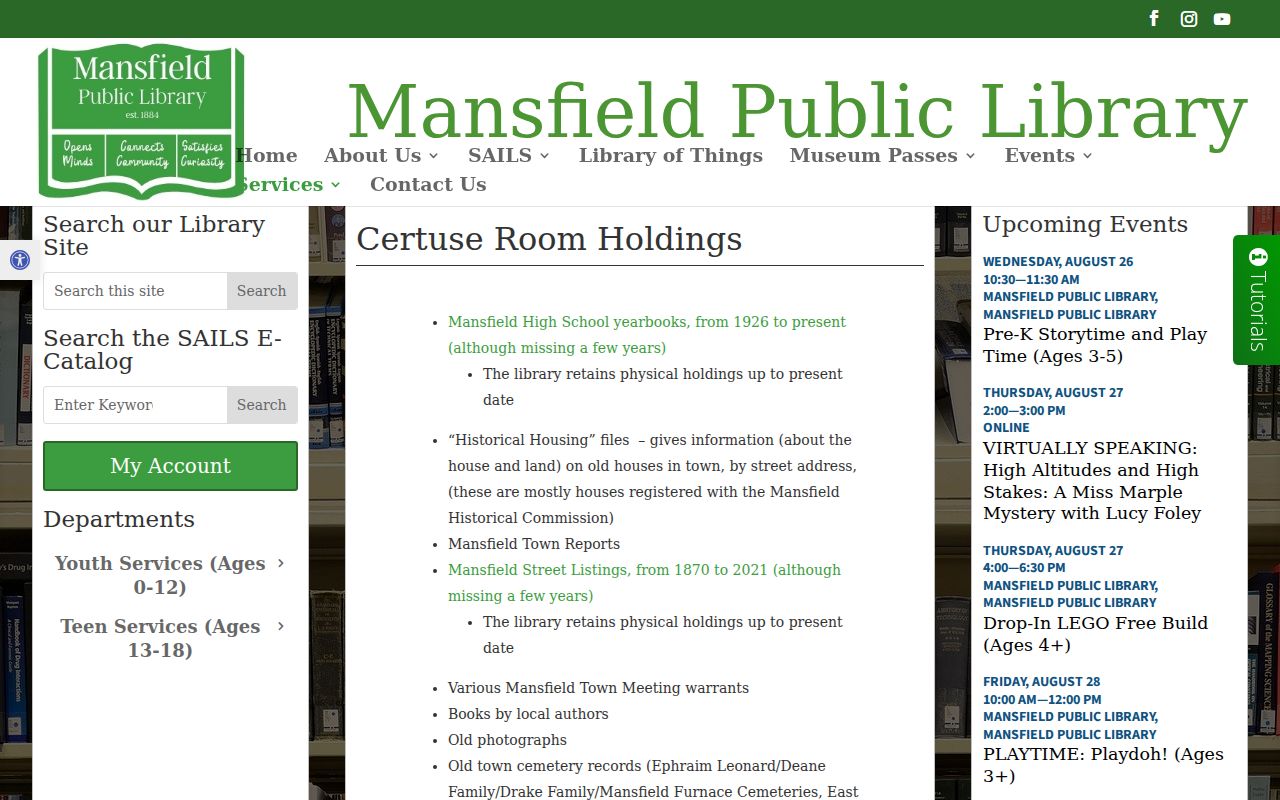
The holdings inventory explains why the local shelf can answer historical address questions that a single digitized volume cannot.
Note: Record the holding name and the date searched, because missing years and uneven house-file coverage are part of the Mansfield collection.
Reading Mansfield Directory Entries
An inhabitant entry in the 1918 Mansfield regional directory can combine a person's name, role or occupation, a business association, residence address, and a local-direction qualifier. The public OCR gives the example “ABBOTT FRANK W laborer h 80 Franklin n East.” Another entry places John C. Ainsworth at Mansfield Bleachery and gives a North Main address. These are examples of the book's notation, not a claim about a person's present life. In particular, the `h` mark means house or residence in the directory key. It is not an ownership mark.
| Name | The entry's printed person name and initials, which may need comparison with a street listing or census. |
|---|---|
| Role or association | An occupation, office, or business reference that can distinguish similarly named people in 1918. |
| Residence | A house number and street, sometimes paired with a local direction or neighboring-place qualifier. |
| Street context | The street section can add starting point, direction, cross streets, town lines, or intersections. |
| Town check | Regional entries require a Mansfield, Norton, or Raynham check before a conclusion is made. |
- Criss-cross directory
- A directory arranged by address or street instead of by name. No verified Mansfield criss-cross shelf run was located, so confirm any local volume with the library.
- Householder index
- A name-oriented portion that identifies a household or resident. The 1918 book's Inhabitants section is the relevant known name-oriented section.
- Abbreviation key
- The volume's explanation of compressed terms. Its 1918 key includes `h` for house, `bds` for boards, E.M. for East Mansfield, and W.M. for West Mansfield.
Mansfield Directory Date Gaps
When a Mansfield directory year is missing, use nearby local material instead of guessing. Mansfield News Online describes public access from 1873 through 1976 and library-only access from 1977 through 2022. The library also reports that a Mass Humanities grant digitized its 1873-1927 holdings. The separate archive interface has different title and year displays, so the library's access statement is the better local description when planning research.
Yearbooks can narrow a school-year connection, but their 1926-present run also has missing years. The newspaper may show an obituary, school event, civic notice, or business change that helps explain a name's appearance or disappearance from a listing. Neither source should be used to infer a current household. The useful result is a dated lead that can be checked against a census, cemetery record, or deed chain when that type of confirmation is appropriate.
Mansfield Directory Research Help
The Mansfield Public Library genealogy service lists a Genealogy Club through 2026. Meetings do not require registration, though the library asks for an email for reminders. Ancestry Library Edition is available only on library internet, and Fold3 Library Edition uses a Mansfield library card. Those access rules make the library a practical handoff when a home search cannot reach the relevant historical tool or a physical volume needs staff help.
The Mansfield History Center, operated by the Historical Society, keeps photos, newspapers, artifacts, books, publications, and local-history material at Copeland House, 53 Rumford Avenue. It is open Saturdays from 10 a.m. to noon, is free, and is not accessible. Research is handled by email or appointment. The Society says its collection is largely unorganized, so a precise request has a better chance than a broad request for every person connected to a place.
Review the library genealogy source before visiting or asking about in-library access.
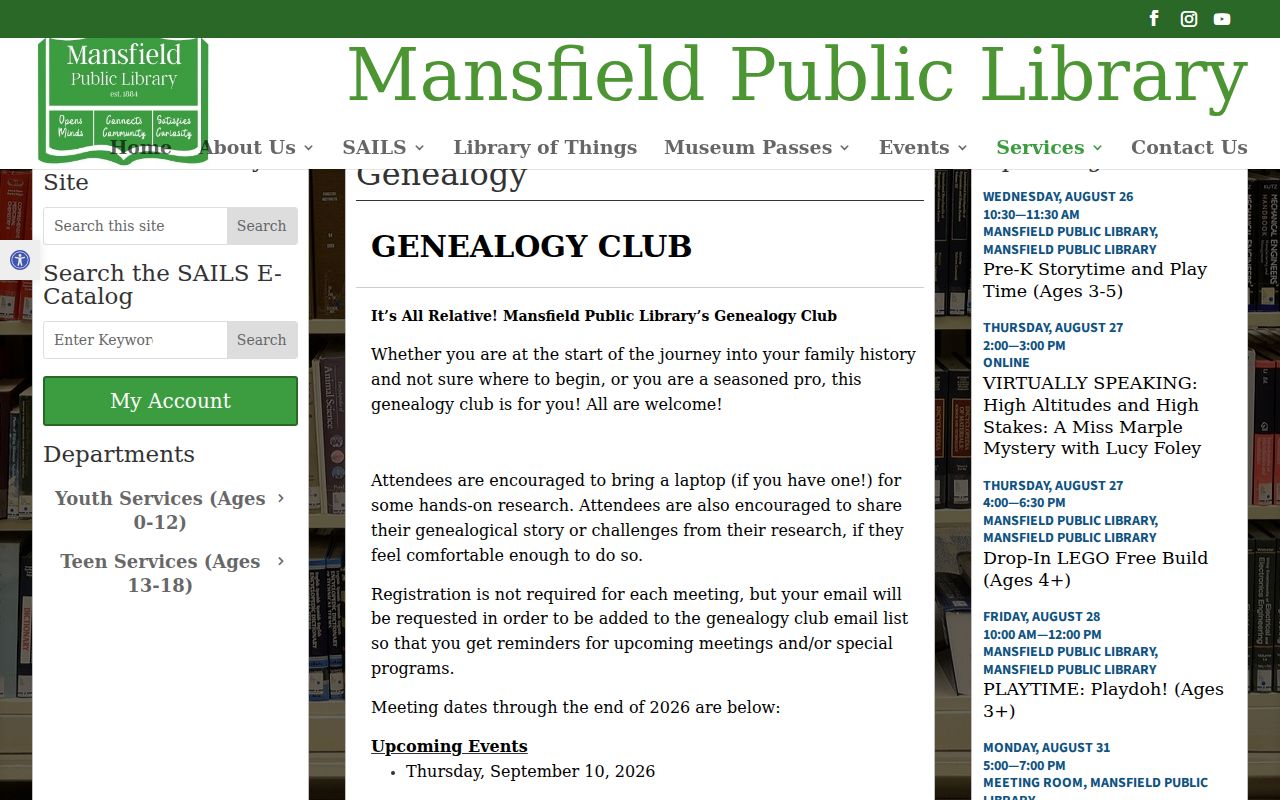
The genealogy resources complement the Mansfield historical-directory holdings with on-site databases, print material, and local research support.
Tracing Mansfield Directory Households
A Mansfield historical-directory trail is strongest when it moves from an address and date to independent historical sources. Start with the street listing or the 1918 street section, then preserve spelling, initials, address, local qualifier, and abbreviation. Check the street section before relying on an inhabitant result because it can reveal cross-street context or an address description that a name search misses. A historical occupant and a title holder are not automatically the same person.
- Locate the person or address in the nearest available Mansfield Street Listing or the 1918 regional directory, and record the exact year and source.
- Check nearby years where the Certuse Room collection has them, noting changes in spelling, initials, address, occupation, or East and West Mansfield abbreviations.
- Read the street section for cross streets, direction, town-line context, and nearby entries before treating an old number as a modern parcel.
- Pair the address-year with the nearest available federal census. Census schedules release under the 72-year rule, so a historical census cannot establish a current household.
- Use Mansfield News, cemetery material, obituary or probate records, and the deed index only to test a dated change such as a move, death, or title transition.
For a present parcel or street-level record trail, the Mansfield street directory keeps the modern address workflow separate from these historical collections. If a directory entry disappears, treat it as a question. A missing issue, a move, an unlisted person, a death, or a regional-town mismatch can all produce the same apparent gap.
Note: Keep the original spelling and abbreviation beside any modern interpretation, especially when E.M. or W.M. appears in a 1918 entry.
Mansfield Historical Collections Split
Mansfield's historical material is distributed across several custodians. The old town hall burned in 1970, while library records, municipal reports, historical-house files, and newspaper collections now sit in both digital and physical channels. The library opened in 1884, moved to the Soldiers' Memorial Building in 1901, and moved to Hope Street in 1989. That local history explains why one request may lead from a digital Town Report to the Certuse Room or History Center rather than to a single online catalog.
| Year | Mansfield collection milestone |
|---|---|
| 1870 | The documented Street Listings run begins, although the Certuse Room reports missing years. |
| 1918 | A.E. Foss publishes the known regional Mansfield, Norton, and Raynham directory. |
| 1926 | The documented Mansfield High School yearbook run begins, with some years missing. |
| 1970 | The old town hall burns, contributing to a split between physical and digital local collections. |
| 2021 | The documented Street Listings run ends at this year on the Certuse Room holdings page. |
Recent municipal records add a related preservation detail. Mansfield's FY2025 material describes a Historic Documents Preservation Grant for digitizing historical DD214 records dated September 22, 1943 through July 6, 1988, covering 4,577 pages, and notes that VitalChek was implemented for online vital-certificate ordering. Those developments concern distinct record types. They do not create a new city-directory run or make all historical resident information publicly searchable.